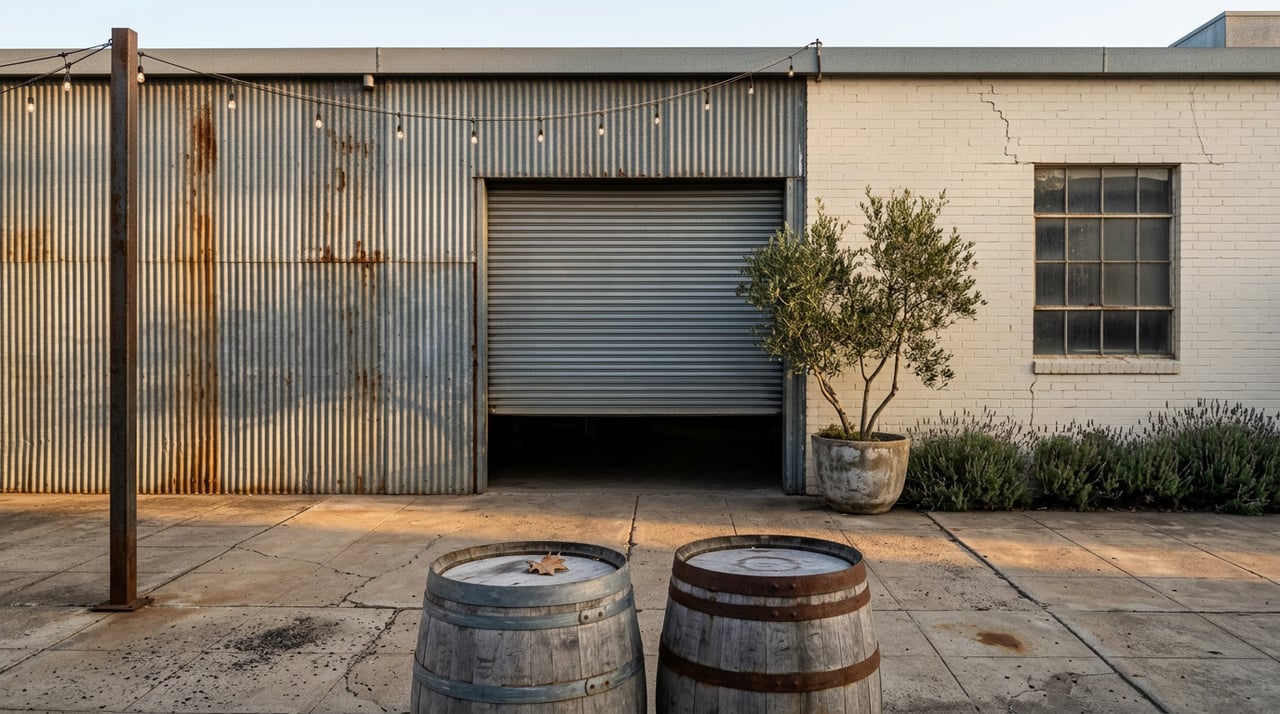
Drive east on Washington Street past Toole's Garage and the stone and cabinetry suppliers that have outfitted half the kitchen remodels on the Peninsula, and you will pass a wine tasting room with no more signage than the auto shop next door. Keep going toward Industrial Road and you will find another one, then a brewery, then a wine garden hosting a Saturday morning car meet. Nothing here is dressed up. That is the point.
Most people who live in San Carlos know Laurel Street. It is the postcard version of downtown: restaurants that turned over almost entirely in the past two years, a Sunday farmers market, a fall festival that closes the street to traffic. Fewer people talk about the other cluster a few blocks east, where the city's wineries and breweries have quietly built a second gathering place inside a working industrial corridor. It never got a rebrand, and that turns out to be exactly why it still feels like something you found rather than something built for you to find.
The four years that changed a pass-through street
The San Mateo Daily Journal reported that Chris Garrett opened Devil's Canyon Brewing Company at 935 Washington Street in the early 2010s, in a stretch of the city better known for lumber yards and marble suppliers than places to sit down for a drink. Within four years, by his own account in the report, the block stopped being a place people drove through and became one where they stopped. Garrett described the neighborhood in that report as "understated and it's aged," which is still an accurate read on it more than a decade later.
That word, understated, is doing real work. Nobody repainted the warehouses or installed matching awnings. The transformation included practical touches: exterior lighting, a place to throw away a coffee cup, and a reason for someone to park the car and walk between two doors instead of one. According to a San Mateo Daily Journal report, the Industrial Arts Business Association, led at points by Dave Toole of Toole's Garage and Paul Rogerville of Cuvée Wine Cellars at 1001 Washington Street, took on projects as unglamorous as installing streetlights and trash cans donated by the San Carlos Rotary Club. Rogerville, who converted a former construction warehouse into a wine tasting room, also painted a mural at the corner of Bayport Avenue and Washington Street, one of the few visual cues that something other than concrete supply happens on that block.
City officials have since credited the district's building-supply and artisan businesses, the cabinetry shops and stone yards that share the same streets as the wineries, with bringing in a disproportionate share of San Carlos's sales tax revenue. That is worth sitting with. The wine bars did not replace the industrial tenants. They moved in next to them, and the mix is what makes the walk interesting.
What's actually poured here
The informal name for this stretch is the Mid-Peninsula Wine Trail, a map covering close to ten wineries and breweries clustered around Washington Street and Industrial Road. On a given weekend you can work your way through:
- Devil's Canyon Brewing Company at 935 Washington Street, open Fridays from 4 to 10 p.m. and one of the taprooms that keeps its doors open through citywide events like SF Beer Week
- Cuvée Wine Cellars at 1001 Washington Street, the tasting room Paul Rogerville built out of his old construction warehouse
- Domenico Winery, a family-owned producer that has been making Cal-Italia wines for more than two decades and runs its own event calendar through the fall, including an annual Orphan Barrel Tasting
- Flying Suitcase Wines and Russian Ridge Winery, both small-batch producers on the same trail
- Woodside Vineyards, whose San Carlos tasting room at 380 Industrial Road pours every weekend with no reservation required
- Blue Oak Brewing Company, a smaller taproom that shows up on the same short list of stops locals make when they are working the district rather than just visiting one address
None of these operations look alike from the outside, and that inconsistency is the tell. A polished district would have matching signage and a shared color scheme. This one has a brewery next to a garage next to a stone supplier next to a tasting room, and the range is exactly what makes it worth the walk instead of a single stop.
A Saturday there in August
The district is not seasonal in the way Laurel Street's festival calendar is, but the summer months are when it shows up most. Earlier this month, the wine garden at 380 Industrial Road ran a late morning car meet called Cars & Cabernet, paired the same week with a live set from a musician blending country and jazz. Neither event required tickets or advance planning. You parked, you walked in, you stayed as long as you wanted.
That casualness extends through the calendar. In late February, when SF Beer Week runs its annual circuit through Silicon Valley, Devil's Canyon keeps its regular Friday hours while running tap takeovers alongside the week's programming, and Out Of The Barrel, a few blocks over on El Camino Real, hosted its third annual Craft Beer Fest and Competition this past February with more than 20 California breweries pouring, the winner crowned by patron vote. None of it asks you to dress for it or book ahead. You show up the way you would show up for a neighbor's backyard gathering, because in a lot of ways that is what it still is.
Why it never became the other Laurel Street
Laurel Street's transformation over the past two years has been the more visible story, with new restaurants filling storefronts left by earlier closures and a downtown that draws people from Redwood City and Belmont on a festival weekend. The Industrial Road district took a different path. City economic development officials have floated ideas over the years for better signage and a formal marketing push to help visitors find the area, and the zoning has stayed flexible enough to let wineries and breweries keep opening inside a corridor still zoned for industrial and artisan use. None of that has turned it into a destination in the way Laurel Street has become one. It has stayed a place locals know about and visitors stumble onto, which fits how the district actually developed: the improvements were practical, from streetlights to trash cans, rather than a formal branding effort.
That is a useful thing to know if you already live in San Carlos and have never made the turn off El Camino onto Washington Street on a Saturday. The wine trail has been there for over a decade, run mostly by the same handful of owners who first organized to keep the sidewalks lit. It still shares block space with a working garage and a marble supplier, and that is not an oversight. It is the reason a walk through it feels like discovering something instead of visiting an attraction someone built for you.
If you are weighing a move to San Carlos, or thinking about what your own property here is worth in a market that keeps rewarding exactly this kind of neighborhood texture, Edelino Chen works this part of the Peninsula closely and can walk you through what a given block, industrial corridor included, actually means for value and lifestyle. Schedule a free consultation to talk through it.