If you have looked at Fremont prices and wondered whether house hacking is still realistic, you are asking the right question. This is a market with strong rents, fast-moving listings, and very high entry costs, so the math rarely works on rent alone. The good news is that there are still smart paths to explore if you focus on the right property types, financing structure, and city rules. Let’s dive in.
Why Fremont house hacking is different
Fremont is not a low-cost market where you can buy a property and expect easy cash flow from day one. Census data shows a 60.2% owner-occupied housing rate, and the median owner-occupied home value for 2019 through 2023 was $1,289,400. Redfin reported a March 2026 median sale price of $1,503,250, with homes averaging about five offers and 13 days on market.
That creates a very specific challenge for buyers. You may be able to offset your monthly payment with rental income, but the purchase price and financing terms will usually drive the deal more than the rent itself. In Fremont, house hacking often works best as a way to reduce your housing cost while building long-term equity, not as a shortcut to strong immediate cash flow.
Fremont rent numbers still matter
Rent levels in Fremont are still meaningful because they can help support your monthly budget. Average apartment rent is about $2,839, with average one-bedroom rent at $2,534 and average two-bedroom rent at $3,105.
Compared with nearby cities, Fremont has a lower rough price-to-rent screen than Oakland, Hayward, and Alameda, but a higher one than Berkeley. That means Fremont sits in an interesting middle ground. Rents are healthy, but home prices are so high that your success usually depends on using rental income as an offset rather than relying on raw yield.
Best house hacking setups in Fremont
Single-family home with an ADU
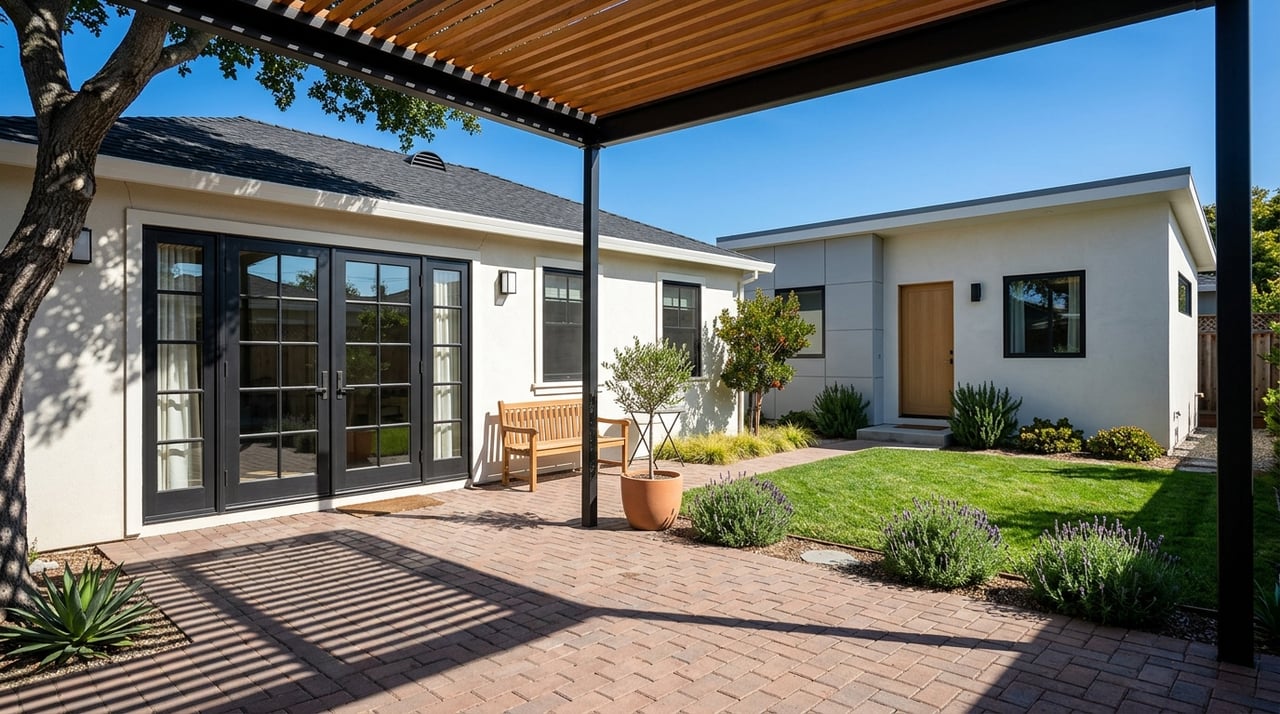
One of the clearest house hacking paths in Fremont is a single-family home with an accessory dwelling unit, or ADU. According to the city, attached ADUs can be up to 1,000 square feet, and detached ADUs can be up to 1,200 square feet. Fremont also allows 4-foot side and rear setbacks for ADUs.
This setup can work well if you want to live in the main home and rent the ADU, or in some cases live in the ADU and use the main home differently depending on your plans and financing. The city states that no additional parking is required for an ADU, and no replacement parking is required if a garage or carport is converted. Fremont also says owner occupancy is not required for an ADU.
There is an important rule to keep in mind. ADUs in Fremont cannot be rented for fewer than 30 days. If your plan depends on short-term rental income, that is a major limitation.
Single-family home with a JADU
A junior accessory dwelling unit, or JADU, can be another option if you want to create smaller rental space within the existing home. In Fremont, a JADU is limited to 500 square feet and must be located within the single-family home or an attached garage.
A JADU can be a useful way to create income from a smaller footprint and lower build cost. But the occupancy rules are tighter than for a standard ADU. If the JADU shares a bathroom with the main residence, the owner must occupy either the primary home or the JADU.
Like ADUs, JADUs cannot be rented for fewer than 30 days. That means they fit better with longer-term rental planning than short-term hosting.
Owner-occupied duplexes
In Fremont, owner-occupied duplexes may offer one of the more practical house hacking models because they can fit the financing box better than many single-family purchases. Alameda County's 2026 conforming loan limit is $1,249,125 for a one-unit property and $1,599,375 for a two-unit property.
That matters because Fremont's March 2026 median sale price of $1,503,250 sits above the one-unit conforming cap by $254,125, but below the two-unit cap by $96,125. In plain terms, a duplex can sometimes be easier to finance within conforming limits than a similarly priced detached house.
If you live in one unit and rent the other, you may also create a cleaner and more direct house hacking structure. This approach can be especially appealing if you want built-in separation between your living space and rental space.
SB 9 potential on qualifying lots
California's SB 9 rules create another path worth watching in Fremont, especially if you are looking at a property with development upside. The California Department of Housing and Community Development says SB 9 can allow up to four units on a qualifying lot through a combination of lot split and two-unit housing development rules.
The same guidance says local agencies must ministerially approve qualifying two-unit housing developments and lot splits, and objective local standards cannot block one or two units of at least 800 square feet each or two 1,200-square-foot lots. For some buyers, that opens the door to a phased house hack strategy with future flexibility.
Still, this is not a shortcut. SB 9 projects depend on lot conditions, zoning context, design standards, and occupancy requirements. For an urban lot split, the applicant must sign an affidavit stating that one unit will be occupied as a principal residence for at least three years.
Financing can make or break the plan
Monthly payment pressure is real
House hacking in Fremont starts with the mortgage payment, not the rent roll. Freddie Mac reported the average 30-year fixed rate at 6.37% on May 7, 2026. On Fremont's March 2026 median sale price, a 20% down purchase implies borrowing about $1.20 million, which works out to roughly $7,499 per month in principal and interest before taxes, insurance, or HOA dues.
That is why buyers need to stress-test the numbers. Even strong rent offsets may only cover part of the carrying cost. A property can still make sense, but you want a clear budget and a realistic expectation for how much help the rental income will provide.
Loan programs to know
Several owner-occupied loan programs are relevant for house hackers in Fremont:
- FHA allows down payments as low as 3.5% on 1-to-4-unit properties.
- Fannie Mae HomeReady can apply to 2-to-4-unit principal residences, requires a 3% borrower contribution above 80% loan-to-value, and may allow ADU rental income in qualifying.
- Freddie Mac Home Possible is available for 1-to-4-unit primary residences, limits qualifying income to 80% of area median income, and may allow ADU rental income if program rules are met.
These options are not one-size-fits-all. But in a high-cost city like Fremont, the right financing structure can have as much impact as the property itself.
City rules and risk points to model
Fremont rent review rules
If you plan to rent out part of your property, you should understand Fremont's local rent review process early. The city's Rent Review Ordinance covers all residential rental units in Fremont, including single-family homes.
The city provides review and a formal hearing process for proposed rent increases above 5% in any 12-month period. Written notices must include landlord contact information, and if the increase is above 5%, the notice must explain the increase.
State rent cap rules may also apply
California's Tenant Protection Act, often called AB 1482, limits many annual rent increases to 5% plus CPI or 10% total, whichever is lower. The Attorney General notes that some units may be exempt, including certain single-family homes and condos not owned by a corporation or REIT, owner-occupied duplexes, and units with certificates of occupancy issued within the last 15 years.
For many Fremont house hacks, the safest approach is to assume you may need to comply with both the statewide rules and Fremont's local rent review process. That can affect your long-term income projections, especially if your strategy depends on larger future rent increases.
Short-term rental assumptions can backfire
This is one of the biggest planning mistakes to avoid. Fremont says ADUs and JADUs cannot be rented for fewer than 30 days.
The city also says a short-term rental of fewer than 30 consecutive nights requires a no-cost short-term rental permit. If your numbers only work with short-stay income, you should treat that as a warning sign and revisit the plan.
Unpermitted units need careful review
Some Fremont properties may already have extra living space that looks useful for a house hack. But if that space was built without permits, you need to verify what is legal before you count on rental income.
Fremont does offer an ADU and JADU amnesty program for units built before January 1, 2020 without permits, if the structure meets the program requirements. In the right situation, that can be more valuable than removing an existing unit, but it still requires careful due diligence.
A smart Fremont house hacking strategy
Focus on payment reduction first
In Fremont, the strongest house hacks usually lower your effective housing cost rather than produce immediate cash flow. If rent from an ADU, JADU, or second unit reduces your monthly payment in a meaningful way, that can still be a strong win in a market with high appreciation pressure and limited inventory.
This mindset helps you stay realistic. Instead of asking whether a property looks amazing on paper, ask whether it improves your monthly budget, supports your financing, and gives you flexibility over time.
Screen for the right structure
As you evaluate properties, it helps to think in categories:
- Existing single-family homes with legal ADUs
- Homes with space and zoning potential for a future ADU or JADU
- Owner-occupied duplex opportunities
- Lots with possible SB 9 upside
- Homes with existing unpermitted units that may qualify for amnesty
Each category comes with a different risk, cost, and timeline. In Fremont, the best match usually depends on your down payment, borrowing strength, renovation appetite, and how much privacy you want between you and your tenant.
Build a conservative model
A conservative house hack model matters more in Fremont than in lower-cost markets. You want to estimate your principal and interest, property taxes, insurance, utilities, maintenance, and any upgrade costs before you rely on projected rent.
Then pressure-test the deal. Ask what happens if the unit takes longer to rent, if your renovation costs rise, or if rent growth is slower than expected under local and state rules.
Why local guidance matters in Fremont
Fremont house hacking can be rewarding, but it is rarely simple. The right opportunity often sits at the intersection of financing, city ADU rules, rent regulations, and property-specific development potential.
If you are comparing a duplex, an ADU-ready home, or an SB 9 candidate, you need a clear plan before you write an offer. Working through the numbers and the local rules up front can help you avoid expensive surprises and spot the properties that truly fit your goals.
If you want help evaluating Fremont house hacking opportunities with a practical, data-driven lens, connect with Edelino Chen. You can get guidance tailored to your budget, risk tolerance, and long-term plans.
FAQs
What makes house hacking in Fremont challenging?
- Fremont has high home prices, with a March 2026 median sale price of $1,503,250, so most house hacks rely on rent offsets and financing structure more than strong initial cash flow.
What ADU rules matter for Fremont house hacking?
- Fremont allows attached ADUs up to 1,000 square feet and detached ADUs up to 1,200 square feet, does not require additional parking for ADUs, and does not allow ADU rentals for fewer than 30 days.
What is a JADU in Fremont?
- A JADU is a smaller unit of up to 500 square feet located within a single-family home or attached garage, and it also cannot be rented for fewer than 30 days.
Why can a duplex be attractive for house hacking in Fremont?
- Alameda County's 2026 conforming loan limit is higher for two-unit properties than for one-unit properties, which can make an owner-occupied duplex easier to finance than a similarly priced single-family home.
Do Fremont rent rules apply to single-family rentals?
- Yes. Fremont's Rent Review Ordinance covers all residential rental units in the city, including single-family homes, and provides review for proposed increases above 5% in a 12-month period.
Can you use short-term rentals for an ADU house hack in Fremont?
- Fremont says ADUs and JADUs cannot be rented for fewer than 30 days, so a short-term rental strategy is generally not a fit for these unit types.
What should you check before buying a Fremont property with an extra unit?
- You should confirm whether the extra unit is permitted, whether it may qualify for Fremont's amnesty program if built before January 1, 2020, and how local rental rules may affect your income plan.